The Bank of Canada Raised Rates to 2.50%. What Does It Mean for a Toronto Mortgage?
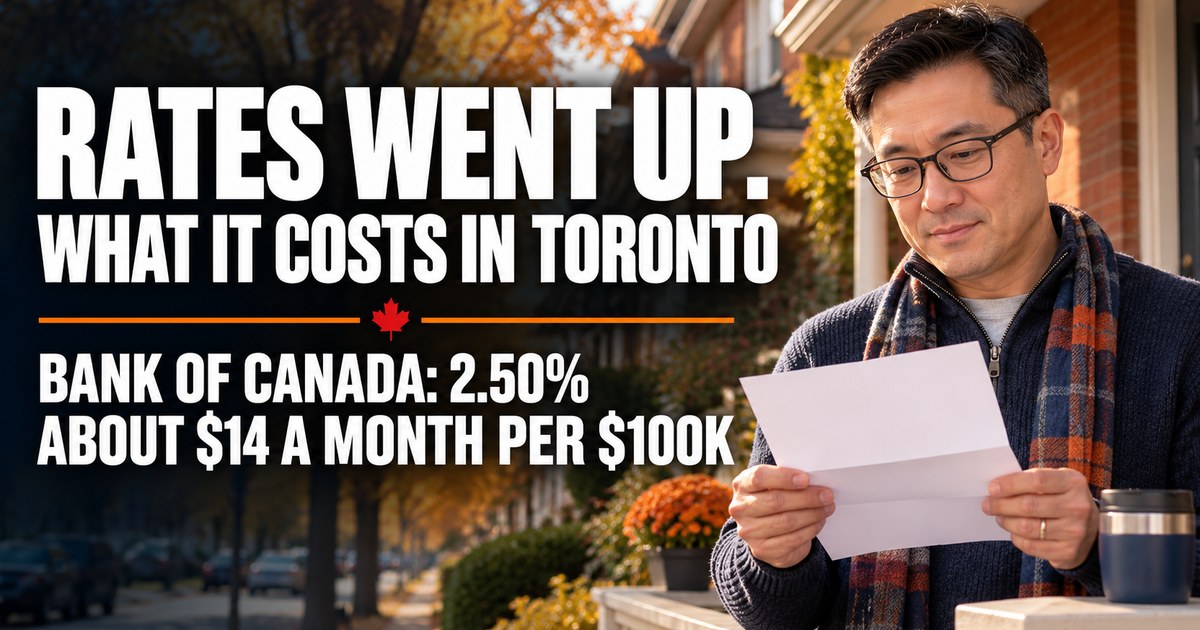
Quick answer: On October 28, 2026 the Bank of Canada raised its policy rate by 0.25 points to 2.50%, its first increase since July 2023. Prime at the big banks goes from 4.45% to 4.70% on October 29. On a $700,000 variable mortgage that’s about $96 a month more. Fixed rates don’t move with the Bank. They follow bond yields, which had already pushed them up this year.
If you have a variable rate, are buying this winter or renew in the next year, here is what changes and what doesn’t.
Why did the Bank of Canada raise rates?
Inflation. The Bank said the conflict in the Middle East, now in its eighth month, is keeping energy prices high for longer. Inflation has been around 3% since April and the Bank expects about 3½% by the end of the year. Without gasoline it was 2.2% in September, and the Bank’s core measures are near 2%. It raised rates to stop high energy costs spreading into the price of everything else (Bank of Canada, October 28, 2026).
It also said “there could be a need to increase the policy rate further,” but that it will proceed carefully. The next decision is December 9.
What happens to my variable-rate mortgage?
Prime rises 0.25 points from October 29, so your variable rate rises by the same amount (RBC, TD). What you feel depends on the kind of variable you have:
- Adjustable payment: your payment goes up, usually from your next payment.
- Fixed payment: your payment stays the same, but more of it goes to interest and less to the balance.
Toronto mortgages are big, so a quarter point is real money. Here’s what it costs on a $700,000 insured mortgage over 25 years, using the best insured variable we track (prime minus 0.75%):
| Variable rate | Monthly payment | |
|---|---|---|
| Before the hike (prime 4.45%) | 3.70% | $3,580 |
| After the hike (prime 4.70%) | 3.95% | $3,676 |
| If the Bank raised twice more | 4.45% | $3,871 |
| Best insured 5-year fixed today | 4.64% | $3,929 |
Variable payments use monthly compounding, fixed uses semi-annual. The “twice more” row is arithmetic, not a forecast.
Did fixed rates go up too?
Fixed rates had already moved. They’re priced off Government of Canada bond yields, and the 5-year yield climbed from 2.67% on February 27 to 3.57% on October 27 (Bank of Canada). The best insured 5-year fixed we track for Ontario borrowers rose from 4.24% in July to 4.64% now. That’s why fixed rates climbed for months while the Bank held at 2.25%.
So the hike narrows the gap between the two. Before today the best insured variable was 0.94 points under the best fixed. Now it’s 0.69. Two more quarter-point hikes would leave variable at 4.45%, still under today’s fixed. Whether the Bank does that is the part nobody knows.
Does this change what I qualify for?
On a fixed rate, no. You’re stress-tested at your contract rate plus 2%, so 4.64% qualifies at 6.64%, the same as yesterday.
On a new variable approval, yes. The qualifying rate rises with prime, from 5.70% to 5.95%. For a household earning $150,000 with $550 a month for property tax and heat, that’s roughly $16,000 less mortgage:
| Qualifying rate | Maximum mortgage (39% of income for housing) |
|---|---|
| 5.70% (variable, before) | about $695,000 |
| 5.95% (variable, after) | about $679,000 |
| 6.64% (5-year fixed) | about $638,000 |
That’s a smaller change than the stress test itself makes. Our stress test explainer has the full method.
What’s the Toronto market doing?
TRREB’s September numbers, the latest out, had 5,040 sales across the GTA, down 9% from a year earlier. New listings were down 14.4% and the average price was $1,006,409, down 5.1% (TRREB, October 6, 2026). TRREB said buyers were holding back over the economy, inflation and borrowing costs.
On a $1 million purchase, a 5% difference in price is $50,000. That’s worth far more than a quarter point.
What should I do now?
- Variable, adjustable payment: check your next statement, and make sure the new payment fits your budget if the Bank goes again in December.
- Variable, fixed payment: ask your lender where your trigger rate is. At some point the payment no longer covers the interest.
- Buying: get a rate hold now. It protects you if rates rise before you buy. It doesn’t beat today’s rate.
- Renewing in the next year: start shopping about 120 days before your maturity date, and compare fixed and variable at today’s prices, not last year’s.
When this doesn’t apply
If you’re in a fixed term, nothing changes until you renew. If your mortgage is with a lender that sets its own prime, check its notice; the numbers here use the big-bank prime. And if your file is self-employed, new to Canada or near the $1.5 million insured cap, the rate is rarely what decides it.
Want to know what this does to your own numbers? Book a 20-minute call with Joshua.
This is general commentary, not financial advice. Rates are the best we tracked from lender rate sheets as of October 28, 2026 and can change daily. The Toronto Bank of Canada page has every decision since 2024.
Frequently asked questions
Did the Bank of Canada raise rates on October 28, 2026?
Yes. It raised its policy rate by 0.25 points to 2.50%, the first increase since July 2023. The big banks' prime rate rises from 4.45% to 4.70% on October 29.
How much will my variable payment go up?
About $14 a month for every $100,000 owing on a 25-year amortization. On a $700,000 mortgage that's about $96 a month. If your payment is fixed and only the rate floats, the payment stays the same and more of it goes to interest.
Does the rate hike change fixed mortgage rates?
Not directly. Fixed rates follow Government of Canada bond yields, which had already risen this year. The best insured 5-year fixed we track for Ontario borrowers was 4.64% on October 28.
Is a variable rate still cheaper than fixed in Toronto?
Today, yes. The best insured variable we track is prime minus 0.75%, or 3.95% on the new prime, against 4.64% for the best insured 5-year fixed. The gap is now 0.69 points, down from 0.94 before the hike.
When is the next Bank of Canada decision?
December 9, 2026. The Bank said there could be a need to raise rates further, and that it will proceed carefully.