How Does the Mortgage Stress Test Work for Toronto Buyers?
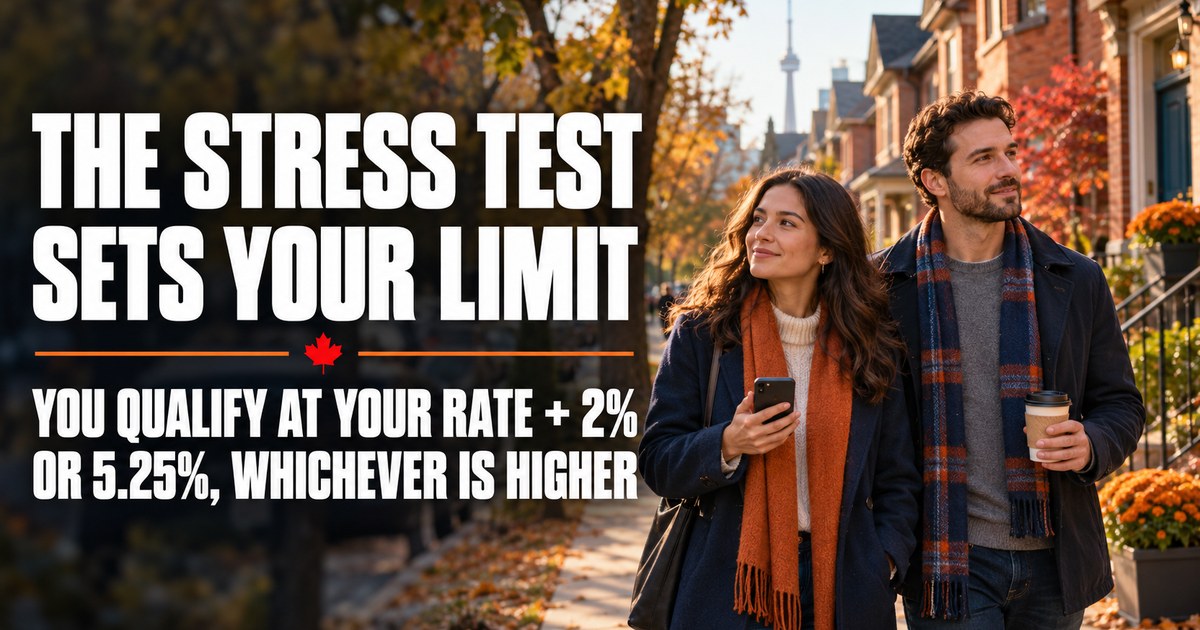
Quick answer: The stress test is the rate a lender uses to decide how much you can borrow. You must qualify at the greater of your contract rate plus 2% or 5.25%, even though you’ll pay your actual rate. At the best insured 5-year fixed we tracked as of September 30, 2026 (4.54%), you’d be tested at 6.54%. On a $150,000 household income, that means about $643,000 of mortgage instead of about $778,000. Your payment is still based on 4.54%.
In Toronto, where prices push most buyers close to their limit, the stress test, not the rate you’re offered, usually decides the most you can spend.
How does the stress test work?
Two rules from two regulators, with the same formula:
- Insured mortgages (less than 20% down): you qualify at the greater of your contract rate plus 2% or 5.25% (CMHC).
- Uninsured mortgages (20% or more down) from federally regulated lenders: the same, the greater of the contract rate plus 2% or 5.25%, under OSFI’s minimum qualifying rate (OSFI).
At today’s rates, the “plus 2%” side is the one that applies, because any contract rate above 3.25% plus 2% is already higher than 5.25%.
The lender then checks two ratios at that qualifying rate. For insured mortgages, your housing costs (the mortgage payment, property tax and heat) can’t be more than 39% of your gross income, and all your debts together can’t be more than 44%.
How much does it change what you can borrow in Toronto?
Here’s an example for a household earning $150,000 a year with no other debts. The $550 a month for property tax and heat is an illustration; your actual tax bill depends on the home.
| Tested at 4.54% (no stress test) | Tested at 6.54% (stress test) | |
|---|---|---|
| Gross monthly income | $12,500 | $12,500 |
| Housing cost limit (39%) | $4,875 | $4,875 |
| Less property tax and heat (example) | $550 | $550 |
| Room for the mortgage payment | $4,325 | $4,325 |
| Largest mortgage that payment supports (25 years) | about $778,000 | about $643,000 |
The stress test takes about $135,000 off what this household can borrow. If they qualify for the full $643,000, their actual payment at 4.54% is about $3,575 a month, well under the $4,325 they were tested at. That gap is the point: it’s room for rates to rise at renewal.
With 20% or more down and an uninsured rate, the numbers move again. At the best uninsured 5-year fixed we tracked (4.94%), the qualifying rate is 6.94%, and the same payment supports about $621,000.
Does the stress test apply when you renew?
If you renew with your current lender, you don’t requalify. If you switch to another federally regulated lender at renewal without borrowing more or stretching the amortization, OSFI says it does not expect lenders to apply the qualifying rate to that uninsured straight switch (OSFI). That makes it easier to shop your renewal. Refinancing, or adding to the mortgage, is a new qualification.
How can you qualify for more under the stress test?
The test itself doesn’t change, but what goes into it can:
- Pay down other debts. A car or credit card payment comes straight out of the 44% limit.
- Use a longer amortization. First-time buyers with an insured mortgage can get up to 30 years, which lowers the qualifying payment.
- Add income. A co-borrower, or rent from a legal suite in the home you’re buying, can count.
- Put more down. A smaller mortgage needs less income to qualify.
What doesn’t help: choosing a variable rate just to qualify. The same contract-plus-2% test applies.
When doesn’t this apply?
Some lenders outside federal regulation set their own qualifying rules, and private lenders lend on different terms, usually at much higher rates. The qualifying rate formula is also reviewed regularly. OSFI says it reviews it at least once a year, so check the current rule before you rely on it.
What should you do next?
Get pre-approved before you look at homes, so you know your stress-tested limit, not just the rate. I’ll show you what you qualify for, what you’d actually pay, and what would change the number. Book a 20-minute call with Joshua Tagg.
This is commentary, not advice. Rates and figures as of October 13, 2026. Rates are the best tracked 5-year fixed rates as of September 30, 2026; income, property tax and heat are examples. All mortgages are subject to lender and insurer approval.
Frequently asked questions
What is the mortgage stress test in Canada?
It's the rate lenders use to check you could still afford your mortgage if rates rose. You qualify at the greater of your contract rate plus 2% or 5.25%, even though your actual payment is at your contract rate.
Does the stress test apply to insured and uninsured mortgages?
Yes. Insured mortgages, with less than 20% down, and uninsured mortgages from federally regulated lenders both use the greater of the contract rate plus 2% or 5.25%.
Do I have to pass the stress test again when I renew?
Not if you renew with your current lender. And OSFI doesn't expect federally regulated lenders to apply it to an uninsured straight switch at renewal, where you move to another lender without increasing the amount or the amortization.
How much does the stress test reduce what I can borrow?
It depends on your income and debts. In our example, a household earning $150,000 a year qualifies for about $643,000 under the stress test, compared with about $778,000 if they were tested at their actual rate.
Is my payment based on the stress test rate?
No. The stress test only decides what you qualify for. Your actual payment is calculated at your contract rate.