Buying Your First Home in Toronto: A Step-by-Step Guide
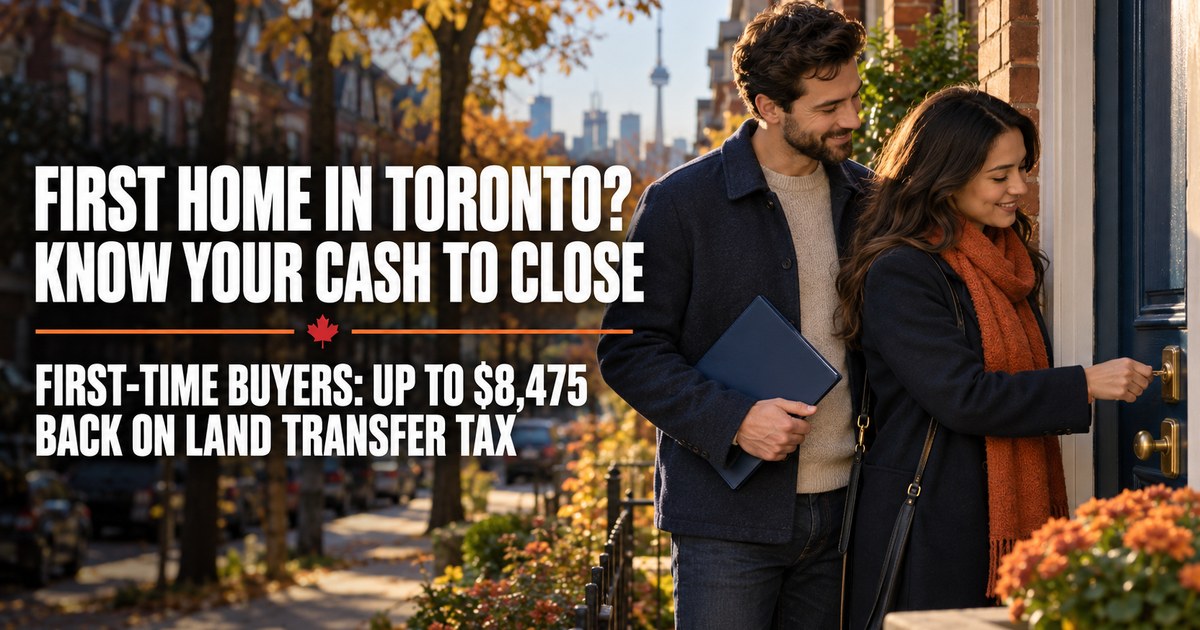
Quick answer: Buying a first home in Toronto runs in four stages: get pre-approved, find the home and make an offer, clear your conditions, then close with a real estate lawyer. The minimum down payment is 5% of the first $500,000 and 10% of the rest up to $1.5 million, so $45,000 on a $700,000 home. On top of that, budget for Ontario’s land transfer tax, Toronto’s own municipal land transfer tax, legal fees and, if you put less than 20% down, Ontario sales tax on the mortgage insurance premium. First-time buyers get up to $4,000 back on the provincial tax.
Toronto is where the cash you need beyond the down payment surprises people most. Here’s the process in order, with the money that goes with each step.
Step 1: Why get pre-approved before you look at homes?
A pre-approval tells you three things before you fall for a house: what you can actually borrow, what the payment will be, and whether anything in your credit or debts needs fixing first. It can also hold a rate for a few months while you shop.
Lenders qualify you at a stress-test rate, not the rate you’ll pay. For an insured mortgage, that’s the greater of your contract rate plus 2% or 5.25% (CMHC). Your housing costs generally can’t exceed 39% of gross income, and all your debts 44%.
Step 2: How much do you need for the down payment?
| Purchase price | Minimum down payment |
|---|---|
| Up to $500,000 | 5% |
| $500,000 to $1.5 million | 5% of the first $500,000 + 10% of the rest |
| $1.5 million or more | 20% (insurance isn’t available) |
Two federal programs can help first-time buyers build it. A First Home Savings Account lets you put in $8,000 a year, up to $40,000, with a tax deduction going in and a tax-free withdrawal for a first home (CRA). The Home Buyers’ Plan lets you take up to $60,000 from your RRSP and repay it over 15 years (CRA). Couples can each use both.
Step 3: What happens when you make an offer?
Your REALTOR® writes an agreement of purchase and sale: price, deposit, closing date, what’s included and any conditions. A financing condition gives you time to get final approval from the lender. An inspection condition lets you check the home. For a condo, you or your lawyer will review the status certificate, which shows the condo corporation’s finances, reserve fund and fees.
In a competitive market, sellers sometimes push for firm offers with no conditions. Only go firm if your financing is already solid, because if the lender says no, you’re still committed to buy.
Step 4: What does the lender check before final approval?
Once your offer is accepted, the lender verifies everything: recent pay stubs, an employment letter, 90 days of bank statements showing your down payment, the purchase agreement and, usually, an appraisal. Clear these before your financing condition deadline. Then waive the condition.
Between approval and closing, don’t finance a car, open new credit or change jobs. The lender can check again before funding.
Step 5: How much cash do you need on closing day?
Here’s the cash for a $700,000 first home with the minimum down payment. It’s an example price, not a market figure.
| Cost | Amount |
|---|---|
| Down payment | $45,000 |
| Ontario sales tax on the CMHC premium (8% of $26,200) | $2,096 |
| Ontario land transfer tax | $10,475 |
| Less: first-time buyer refund | −$4,000 |
| Toronto municipal land transfer tax | $10,475 |
| Less: Toronto first-time buyer rebate | −$4,475 |
| Legal fees, title insurance, adjustments | Get a quote from your lawyer |
| Cash so far | $59,571, before legal fees and moving |
The CMHC premium itself, $26,200 at 4.00% of the $655,000 loan, is added to the mortgage. The 8% Ontario sales tax on it can’t be, so it’s cash at closing (CMHC).
The provincial land transfer tax uses Ontario’s published brackets (Ontario Ministry of Finance). The first-time buyer refund is up to $4,000, which covers the full provincial tax on the first $368,000 (Ontario). Toronto then charges its own municipal land transfer tax on top, using the same brackets up to $2 million, with its own first-time buyer rebate of up to $4,475 (Toronto Municipal Code, Chapter 760). That second tax is the line most people forget.
At the best insured 5-year fixed rate we tracked as of September 30, 2026 (4.54%), the $681,200 mortgage (including the premium) works out to about $3,785 a month over 25 years.
Step 6: What happens on closing day?
In Ontario, your real estate lawyer does the heavy lifting. They search the title, receive the lender’s instructions, collect your closing funds and the land transfer tax, register the transfer and your mortgage, and release the money to the seller’s lawyer. Once registration is done, you get the keys.
Have your home insurance in place before closing. The lender will want proof.
When doesn’t this apply?
The Ontario land transfer tax refund has a stricter definition of “first-time buyer” than the federal programs. If you’ve ever owned a home anywhere in the world, you don’t qualify, even if you’d still qualify for an FHSA. If you’re buying a newly built home, HST and new-home rebates come into it and the closing looks different. And at $1.5 million or more, there’s no mortgage insurance, so the minimum is 20% down.
What should you do next?
Start with the pre-approval, before you book a single showing. I’ll give you your real price range and a cash-to-close estimate for the homes you’re looking at. Book a 20-minute call with Joshua Tagg.
This is commentary, not advice. Rates and figures as of October 8, 2026. Tax and rebate amounts are set by the Province of Ontario and the City of Toronto and can change. All mortgages are subject to lender and insurer approval.
Frequently asked questions
What's the first step to buying a home in Toronto?
Get pre-approved for a mortgage before you look at homes. It tells you your real price range, flags any credit or debt issues while there's time to fix them, and can hold a rate while you shop.
How much cash do I need to buy a first home in Toronto?
The down payment, plus closing costs. On a $700,000 home that's a $45,000 minimum down payment, $2,096 of Ontario sales tax on the mortgage insurance premium, Ontario land transfer tax of $6,475 after the first-time buyer refund, and Toronto's municipal land transfer tax of $6,000 after the City's first-time buyer rebate, before legal fees and moving.
Do first-time buyers pay land transfer tax in Toronto?
Yes, but with rebates. Ontario refunds up to $4,000 of provincial land transfer tax for eligible first-time buyers, and the City of Toronto rebates up to $4,475 of its municipal land transfer tax. Together they cover the full tax on a first home up to $368,000.
Who counts as a first-time buyer for the Ontario land transfer tax refund?
You must be at least 18, a Canadian citizen or permanent resident, and never have owned a home anywhere in the world. You must also live in the home within nine months of buying it. This is stricter than the federal FHSA and Home Buyers' Plan rules.
Do I need a lawyer to buy a house in Toronto?
Yes. In Ontario, a real estate lawyer handles the title search, registers the transfer and your mortgage, collects the land transfer tax and releases the funds on closing day.