5% vs 20% Down in Toronto: Which Down Payment Makes Sense?
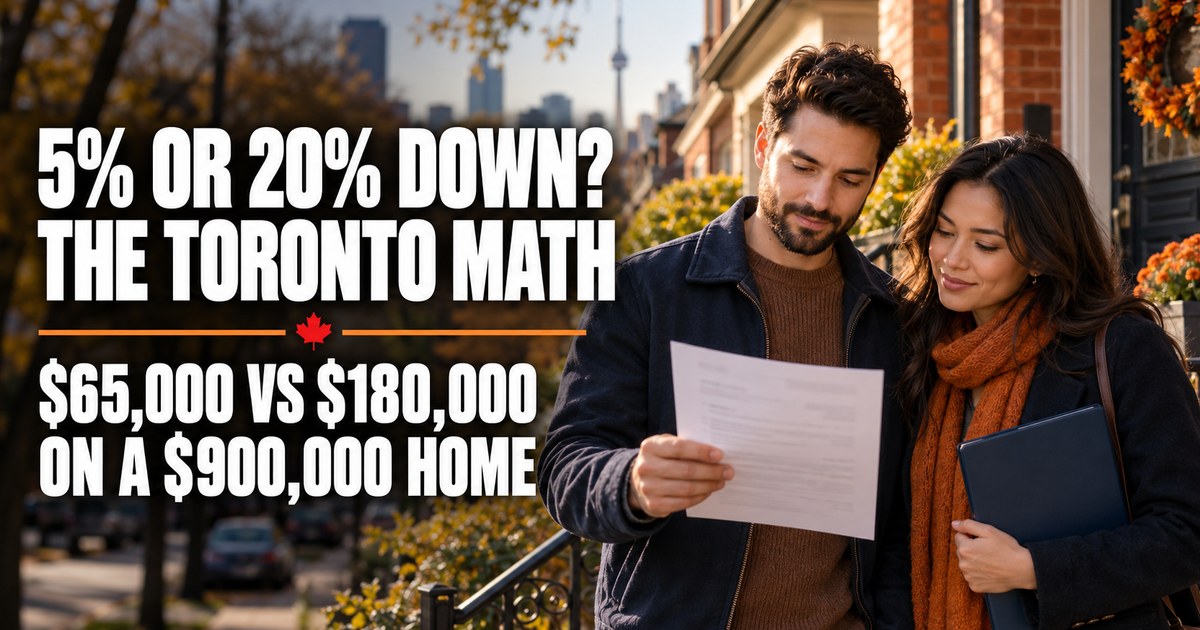
Quick answer: In Toronto the minimum down payment is 5% of the first $500,000 and 10% of everything between $500,000 and $1.5 million. On a $900,000 home that’s $65,000, or about 7.2%. Anything under 20% needs mortgage default insurance, and in Ontario you also pay provincial sales tax on that premium in cash. 20% down ($180,000 on the same home) skips the insurance, but it can take years longer to save.
Most first-time buyers hear “5% down” and assume it’s 5% of the price. In Toronto, where most homes sell well above $500,000, that’s rarely true. Knowing the real minimum, and the real cost of the insurance that comes with it, changes how long you need to save.
How is the minimum down payment calculated on a Toronto home?
The federal rules use a sliding scale. Since December 15, 2024, insured mortgages are available on homes priced under $1.5 million, up from the old $1 million cap (Department of Finance).
| Purchase price | Minimum down payment | As a % of price | 20% down |
|---|---|---|---|
| $500,000 | $25,000 | 5.0% | $100,000 |
| $900,000 | $65,000 | 7.2% | $180,000 |
| $1,200,000 | $95,000 | 7.9% | $240,000 |
| $1,500,000 | $300,000 (no insurance available) | 20.0% | $300,000 |
That last row is the cliff. Just under $1.5 million, you can buy with roughly 8.3% down. At $1.5 million or above, insurance isn’t available and the minimum jumps to 20%. If you’re shopping near that line, a few thousand dollars of price can mean a six-figure change in what you need saved.
What does mortgage insurance cost when you put less than 20% down?
Any mortgage above 80% of the home’s value needs default insurance. CMHC’s premium is a percentage of the loan, and it’s added to your mortgage (CMHC premium table):
| Down payment | Loan-to-value | Premium (% of loan) |
|---|---|---|
| 5% to 9.99% | 90.01% to 95% | 4.00% |
| 10% to 14.99% | 85.01% to 90% | 3.10% |
| 15% to 19.99% | 80.01% to 85% | 2.80% |
| 20% or more | 80% or less | No insurance required |
Here’s the part that’s specific to Ontario. Ontario charges provincial sales tax on the premium, and CMHC states it can’t be added to the loan. Ontario’s retail sales tax on insurance premiums is 8% (Ontario Ministry of Finance). So the tax is extra cash you need on closing day, on top of your down payment and the land transfer tax.
5% vs 20% down on a $900,000 Toronto home
This is an example price to show the arithmetic, not a market average. Rates are the best available 5-year fixed rates we tracked as of September 30, 2026: 4.54% insured, 4.94% uninsured. Both use a 25-year amortization.
| Minimum down | 20% down | |
|---|---|---|
| Down payment | $65,000 | $180,000 |
| Mortgage before insurance | $835,000 | $720,000 |
| Insurance premium (4.00%) | $33,400, added to the loan | $0 |
| Ontario sales tax on premium (8%) | $2,672 cash at closing | $0 |
| Total mortgage | $868,400 | $720,000 |
| 5-year fixed rate | 4.54% | 4.94% |
| Monthly payment | about $4,826 | about $4,163 |
The 20% buyer pays about $663 a month less. But look at the rates. The insured mortgage gets the lower rate, because the lender’s risk is covered by the insurer. That narrows the gap you’d expect from a $148,400 smaller loan.
The real cost of choosing 20% is time. In this example, the 20% buyer needs about $112,000 more cash than the minimum-down buyer, counting the sales tax. If saving that takes three or four years, the question is what happens to prices and to your rent in the meantime. Nobody can promise you either way.
Which first-time buyers should put 20% down?
20% down makes sense when you already have the money and putting it down still leaves you a real cushion. It also helps when your income is tight against the qualifying ratios. A smaller mortgage is easier to qualify for under the stress test.
The minimum is often the better choice when:
- your income is solid but your savings are still building,
- you’d otherwise drain every dollar to reach 20% and have nothing left for closing costs, Toronto’s two land transfer taxes or the first year of repairs,
- you’re a first-time buyer who’d use the 30-year amortization available on insured mortgages to lower the payment.
Many buyers land in between. Moving from the minimum to 10% down cuts the premium from 4.00% to 3.10%, which on our $900,000 example saves about $8,000 of premium.
When doesn’t this apply?
These rules are for owner-occupied homes with one or two units. Rental properties, homes with three or four units, and homes at $1.5 million or more follow different down payment rules. Gifted down payments are allowed, but lenders want a signed gift letter and proof the money is in your account. If your down payment comes from a non-traditional source, such as borrowed funds, the premium can be higher than the table above. And every number here assumes you qualify on income. If your debt ratios are tight, the down payment may need to be bigger than the minimum regardless.
What should you do next?
Get both scenarios run on the price you’re actually shopping and the income you actually have. That means the premium, the Ontario sales tax, the payment and what you qualify for at each down payment. Then you can decide whether to keep saving on purpose. Book a 20-minute call with Joshua Tagg.
This is commentary, not advice. Rates and figures as of October 8, 2026. Rates are the best tracked 5-year fixed rates as of September 30, 2026 and change often. All mortgages are subject to lender and insurer approval.
Frequently asked questions
What is the minimum down payment on a home in Toronto?
5% of the first $500,000 of the price plus 10% of the portion between $500,000 and $1.5 million. On a $900,000 home that is $65,000. At $1.5 million or more, mortgage insurance isn't available and the minimum is 20%.
Do I need mortgage insurance if I put less than 20% down?
Yes. Any mortgage over 80% of the home's value needs default insurance from CMHC, Sagen or Canada Guaranty. The premium is a percentage of the loan, from 2.80% to 4.00% depending on your down payment, and it is added to your mortgage.
Do I pay sales tax on mortgage insurance in Ontario?
Yes. Ontario charges provincial sales tax on the default insurance premium, and it can't be added to the mortgage. On a $33,400 premium, that's about $2,672 you need in cash on closing day.
Is it better to put 20% down in Toronto?
Not automatically. 20% down avoids the insurance premium and lowers your payment, but insured mortgages usually get lower rates, and saving the extra can take years. The right answer depends on your savings, your timeline and how much cash you keep after closing.
What happens if the home costs $1.5 million or more?
Default insurance isn't available at $1.5 million and above, so you need at least 20% down, which is $300,000 on a $1.5 million home. Fewer lenders compete for these files, so shopping the rate matters more.